
Looking for simple ways to support early learning without relying on a screen for every activity? Printable preschool worksheets can help families introduce letters, numbers, shapes, matching, colouring, and simple puzzles at home. With a printer, crayons, pencils, and a few everyday objects, parents can turn free printable preschool worksheets into a short activity that fits into an ordinary day.
Worksheets are not a replacement for play, movement, stories, conversation, or hands-on exploration. They are one option in a balanced routine. Digital learning tools can also be useful when the content is high quality and an adult joins in, as the KidsHealth guide to preschool media use recommends.
This guide explains how to choose printable preschool worksheets, match activities to learning goals, plan five days of simple activities, and adapt a worksheet when a child loses interest. Use the ideas flexibly and follow your child’s abilities, interests, and comfort.
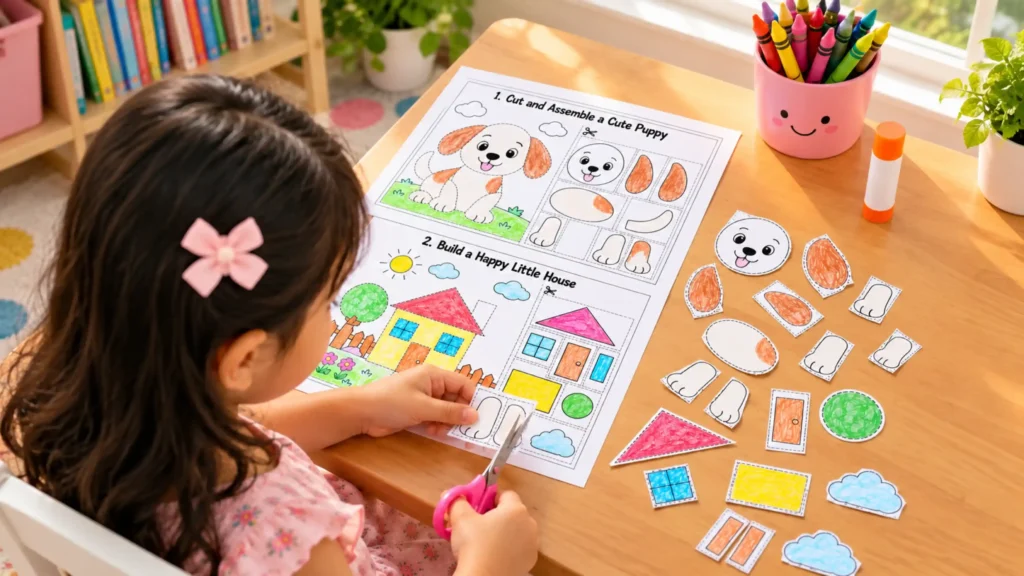
Why include hands-on activities in a preschool routine?
Young children learn through a variety of experiences. A paper activity can provide a clear, manageable way to practise one task while an adult talks with the child, notices their approach, and offers support when needed. Used this way, worksheets become screen-free learning activities rather than drills.
- Early literacy: Letter hunts, letter-picture matching, and looking for the first letter in a name can introduce print. Pair preschool alphabet worksheets with picture books and everyday conversation instead of expecting a child to memorise letters from repeated drills.
- Early numeracy: Counting pictures and matching numerals to quantities can connect written numbers with real objects. Count blocks, toy animals, or pieces of fruit together before marking an answer.
- Fine-motor practice: Drawing lines, colouring large shapes, and preschool tracing worksheets with broad paths provide opportunities to practise controlled hand movements. Try chunky crayons or a larger sheet when a small worksheet feels difficult.
- Visual recognition: Picture matching, shape sorting, and simple patterns encourage children to compare details and notice similarities.
- Creative expression: Colouring and drawing can prompt conversation and storytelling. The result does not need to look perfect; the process and the child’s choices matter.
These are opportunities to practise skills, not guarantees of developmental outcomes. Worksheets should not be presented as a treatment for attention difficulties or as a substitute for professional advice when developmental concerns persist.
Educational apps vs. printable worksheets
The best choice depends on the learning goal, the child’s preferences, and the context. Neither format is automatically better for every child preschool tracing worksheets.
| Factor | Educational apps | Printable worksheets |
|---|---|---|
| Interaction | Touch, audio, animation, and sometimes immediate feedback | Marking, tracing, drawing, matching, and physical materials |
| Adult role | Help choose appropriate content and discuss what is shown | Explain a task, ask questions, and notice the child’s approach |
| Useful examples | Audio-supported letter sounds or a guided demonstration | Pencil-control practice, matching, colouring, and paper puzzles |
| Things to watch | Ads, autoplay, notifications, privacy, and what screen use replaces | Tasks that are too hard, frustration, and too much seated worksheet time |
Best printable preschool worksheets by learning goal
| Activity | Practice goal | Make it practical |
|---|---|---|
| Alphabet hunt | Letter awareness | Find a letter in the child’s name or a favourite book. |
| Count and match | Counting and number recognition | Count blocks or toys, then match the group to a numeral. |
| Colouring page | Creative choices and controlled marking | Ask the child to describe the picture and choose colours. |
| Picture matching | Visual comparison | Match printed pictures to real objects where possible. |
| Shape tracing | Shape recognition and hand movement | Find circles, squares, and triangles around the home. |
| Simple maze | Trying a route and planning | Trace the path with a finger before using a crayon. |
| Cut-and-paste shapes | Shape recognition and sequencing | Use child-safe scissors only with appropriate adult supervision. |
Preschool alphabet worksheets that make letters meaningful
Preschool alphabet worksheets work best when letters connect to something the child already cares about. Start with the letters in their own name, then look for letters on cereal boxes, street signs, and favourite books.
- Name first: Trace or colour the first letter of the child’s name before introducing new letters.
- Sound, then shape: Say the letter sound together and find an object that starts with it before marking the page.
- A few letters at a time: Two or three letters in a week is plenty. Revisit them in play rather than adding more pages.
- Big before small: Use large letters with wide spacing. Smaller print can come later, once hand control improves.
How to choose printable preschool worksheets that fit your child
Age labels can help, but children of the same age have different interests and abilities. Choose a page that is understandable and offers a small challenge, rather than selecting it by age label alone preschool counting worksheets.
For children just starting
Try large pictures, broad paths, simple matching, free drawing, and one-step instructions. Let the child point, talk, or move objects instead of requiring every answer to be written preschool alphabet worksheets.
For children ready for more structure
Try simple tracing, counting small groups, letter-picture matching, shape patterns, or easy mazes. Demonstrate one example if needed and keep the page uncluttered.
For older preschoolers
Offer more detailed mazes, simple sequencing, patterns, and counting activities with one extra step. Increase difficulty gradually and avoid equating speed with learning.
A five-day screen-free printable activity plan
Use this plan as a starting point, not a strict schedule. One short activity is enough. Follow it with play, movement, reading, or exploration.
| Day | Activity | Try together | Focus |
|---|---|---|---|
| Monday | Letter hunt | Find a letter in the child’s name and in a book. | Letter awareness |
| Tuesday | Count and match | Count blocks or toy animals and match the amount. | Early numeracy |
| Wednesday | Colour and draw | Ask the child to tell a story about their picture. | Creativity and language |
| Thursday | Shape matching | Match printed shapes to objects at home. | Visual recognition |
| Friday | Simple maze | Test the route with a finger before drawing it. | Planning and hand control |
At the end of the week, repeat a favourite activity or simplify one that felt difficult. Completing every page is not the goal; the aim is to make learning manageable and positive early learning worksheets.
Build a flexible daily routine
| Moment | Possible activity | Practical tip |
|---|---|---|
| After breakfast | Letter, number, or matching page | Try a calm moment when the child is rested. |
| After active play | Short puzzle or shape activity | Allow a transition and a break if needed. |
| Quiet afternoon | Drawing or colouring | Offer a choice between two suitable pages. |
| Evening | Read a picture book together | A story may suit wind-down time better than a worksheet. |
Tips to keep worksheet time positive
- Give one instruction at a time. Demonstrate the first step, then let the child try.
- Pair paper with real objects. Use blocks for counting, household objects for shapes, and toys for matching.
- Offer limited choices. Let the child choose between two appropriate pages.
- Praise effort specifically. Notice trying, comparing, or testing another route rather than demanding perfect results.
- Take breaks and move. Alternate seated activities with outdoor play, building, dancing, stories, and imaginative play.
- Stop when frustration rises. Pause or switch activities if the child is tired or repeatedly asks to stop. If concerns about development persist, speak with a qualified professional. The CDC’s free milestone checklists can help you prepare questions.
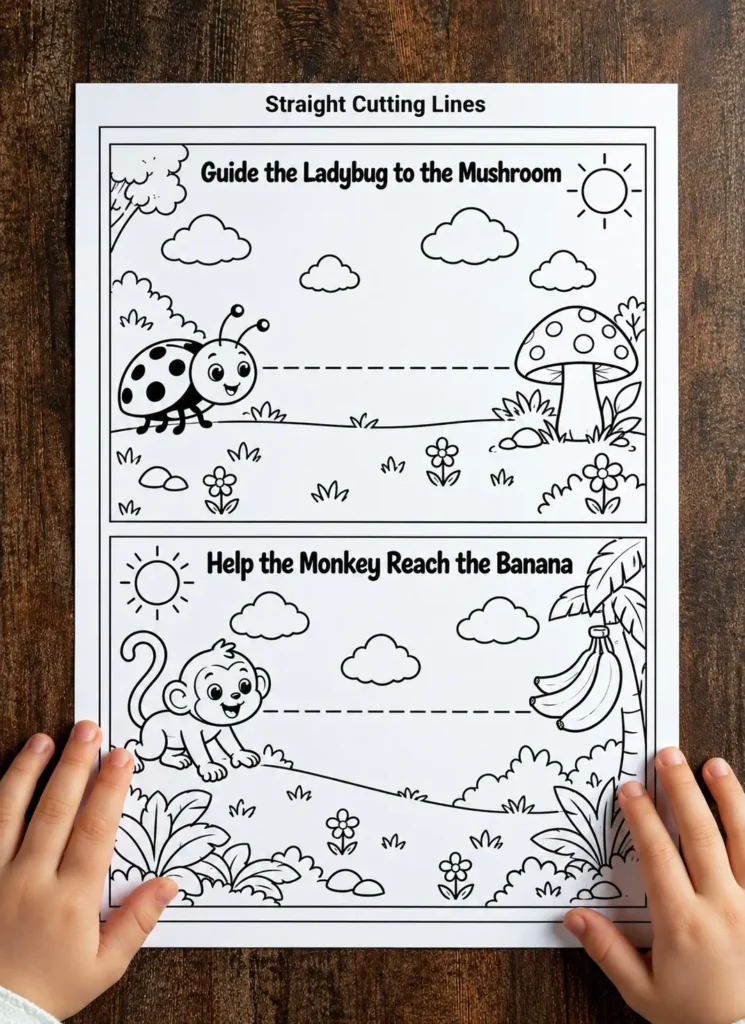
Preschool tracing worksheets: build hand control step by step
Preschool tracing worksheets are most useful when the difficulty rises slowly. Children usually manage straight, wide paths before curves, and curves before zigzags or letter shapes.
- Straight lines: Short, thick paths from left to right, such as a bee flying to a flower.
- Gentle curves: Rainbows, hills, and waves with plenty of space on either side.
- Zigzags and loops: Mountains, springs, and spirals once curves feel comfortable.
- Shapes and letters: Circles, squares, and simple letters with start dots and arrows.
Let the child trace each path with a finger first, then with a chunky crayon. Staying near the line matters more than staying perfectly on it.
If your child dislikes tracing or loses interest
Tracing is not the right first activity for every child. Try drawing large lines in the air, making paths on a large sheet, tracing a route with a finger, and then offering a smaller worksheet if the child is ready. Stickers, matching cards, blocks, picture books, and pretend play can explore similar ideas without requiring pencil work printable activities for preschoolers.
Free printable preschool worksheets vs. paid packs: what to check
Free printable preschool worksheets are a good way to test whether a format suits your child before you spend money. Paid packs usually add more pages, a clear progression, and a consistent design. Whichever you choose, check the same things before you print.
- Real previews: You should be able to see actual pages, not only a cover image.
- Clear skill level: Look for a stated skill level or age range, plus the supplies needed.
- Print-friendly design: Black-and-white or low-ink pages save colour cartridges.
- Honest pricing: A resource labelled free should be fully free, with no hidden sign-up to unlock pages.
The same checks apply to any early learning worksheets you download. You can browse ready-to-print packs in the CraftLoom shop, and if there is a theme you would like us to create, suggest a product.
Make printable preschool worksheets easy to use
Print a small selection before committing to a large workbook. Check that lines and pictures are clear at the chosen print size and set up a comfortable writing surface. Black-and-white pages can reduce colour-ink use and leave room for children to add their own colours.
If you offer a downloadable resource, state exactly what is included, any recommended skill level, the supplies required, and whether it is free or paid. Show preview images of the real pages so parents can judge suitability. Never label a resource free unless it is genuinely available at no cost.
Frequently asked questions
What are printable preschool worksheets good for?
They can provide structured opportunities to practise early literacy, counting, matching, drawing, and controlled marking. Use them alongside play, conversation, movement, stories, and exploration.
Are worksheets better than educational apps?
Not in every situation. Worksheets offer paper-based practice; carefully chosen apps may offer audio, demonstrations, or interactive feedback. Select the format that suits the learning goal and use it thoughtfully.
Can worksheets improve a child’s attention span?
A manageable activity gives a child an opportunity to practise staying with one task, but results vary. Worksheets are not a treatment for attention difficulties.
How long should a preschool child use a worksheet?
There is no universal duration. Start with a short task, observe the child’s comfort and interest, offer breaks, and stop if they become tired or frustrated.
What supplies are needed?
Usually, printed pages and crayons or pencils are enough. Some activities use blocks, toys, glue, or child-safe scissors. Supervise cutting and activities involving small objects.
Can the same worksheet be reused?
Yes, if the child enjoys it and repetition is useful. You can also repeat the underlying concept using real objects or a blank sheet.
Are preschool tracing worksheets suitable for three-year-olds?
They can be, if the paths are short and wide. Many three-year-olds enjoy tracing with a finger or a chunky crayon first. If fine-motor tasks feel very hard, switch to play-based activities and talk to your child’s doctor if you have concerns.
Conclusion: Make screen-free learning practical
Printable preschool worksheets can help families introduce purposeful activities at home. Letter hunts, counting pages, colouring, shape matching, and simple mazes provide different ways to practise skills using paper and real objects.
Start with one activity that suits your child’s interests, keep the instructions simple, and connect the worksheet to play or conversation. The goal is not to eliminate every screen or complete as many pages as possible. It is to create a balanced routine with room for technology, play, movement, stories, and family connection.
Ready to start? Choose one activity from the five-day plan for tomorrow, print two or three printable preschool worksheets that match it, and browse the CraftLoom shop when you want a ready-made pack. Questions about printing or downloads are answered in our FAQs.